And one four-star inside those five puts the badge out of reach — then costs you five more perfect stays to undo. Start with where you are now.
Fill in your first five guests as they come. Most new hosts have never seen this calculation.
Where every new listing starts. Guests see no score at all, and Airbnb has nothing to rank you on.
Watch a brand-new host and they pour everything into getting booked — the photos, the price, the promotion. Almost none of that energy goes into the reviews those bookings are supposed to produce. Which is backwards, because getting booked is the easy half. Airbnb even hands you a discount to help.
The reviews are the hard half, and the important one. They're what the platform ranks you on, what the next guest actually trusts, and the one thing you can't buy, fake, or rush without putting your account at risk. Get the first five right and everything else gets easier. Get them wrong and no amount of bookings digs you out.
This is the system for getting them right — in the order a new host should actually work through it.
Every guide says reviews matter. Almost none say that Airbnb has published the exact number at which its ranking machinery switches on.
Your overall star rating becomes publicly visible. Below this, guests see a listing with no score at all — which is why the first stretch feels like shouting into a void.
Guest Favorite eligibility opens, along with percentile ranking and the top-1%, 5% and 10% highlight on your listing page. Airbnb compares only listings that have cleared five.
Both thresholds are in Airbnb's own help documentation, article 3495. Read it before you take a word of this on trust — that page is the foundation the whole system is built on.
At five reviews there's no denominator to hide in. One guest having a mediocre Tuesday drops you below the line — and climbing back is far slower than falling.
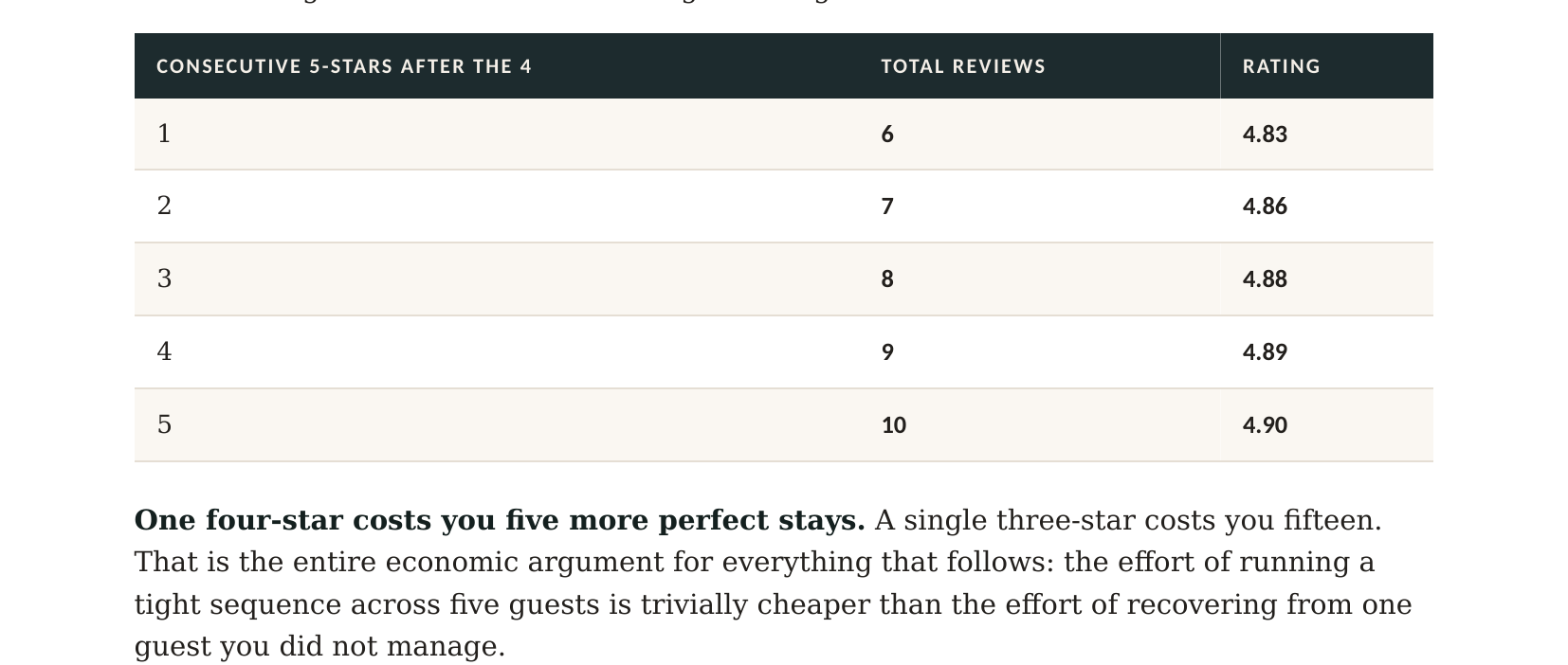
One four-star costs you five more flawless stays. A single three-star costs you fifteen. That's the whole economic case for running a system across five guests instead of improvising.
| Starting from four 5-stars and one 4-star | Rating |
|---|---|
| Where you are | 4.80 |
| After 1 more perfect stay | 4.83 |
| After 2 | 4.86 |
| After 3 | 4.88 |
| After 4 | 4.89 |
| After 5 | 4.90 |
Collection is the easy half. Most guests who had a fine stay will review if you ask them properly, and that takes one message.
The hard half is uniformity — making sure no guest ever quietly absorbs a small irritation and pays you back for it in a star rating a week later.
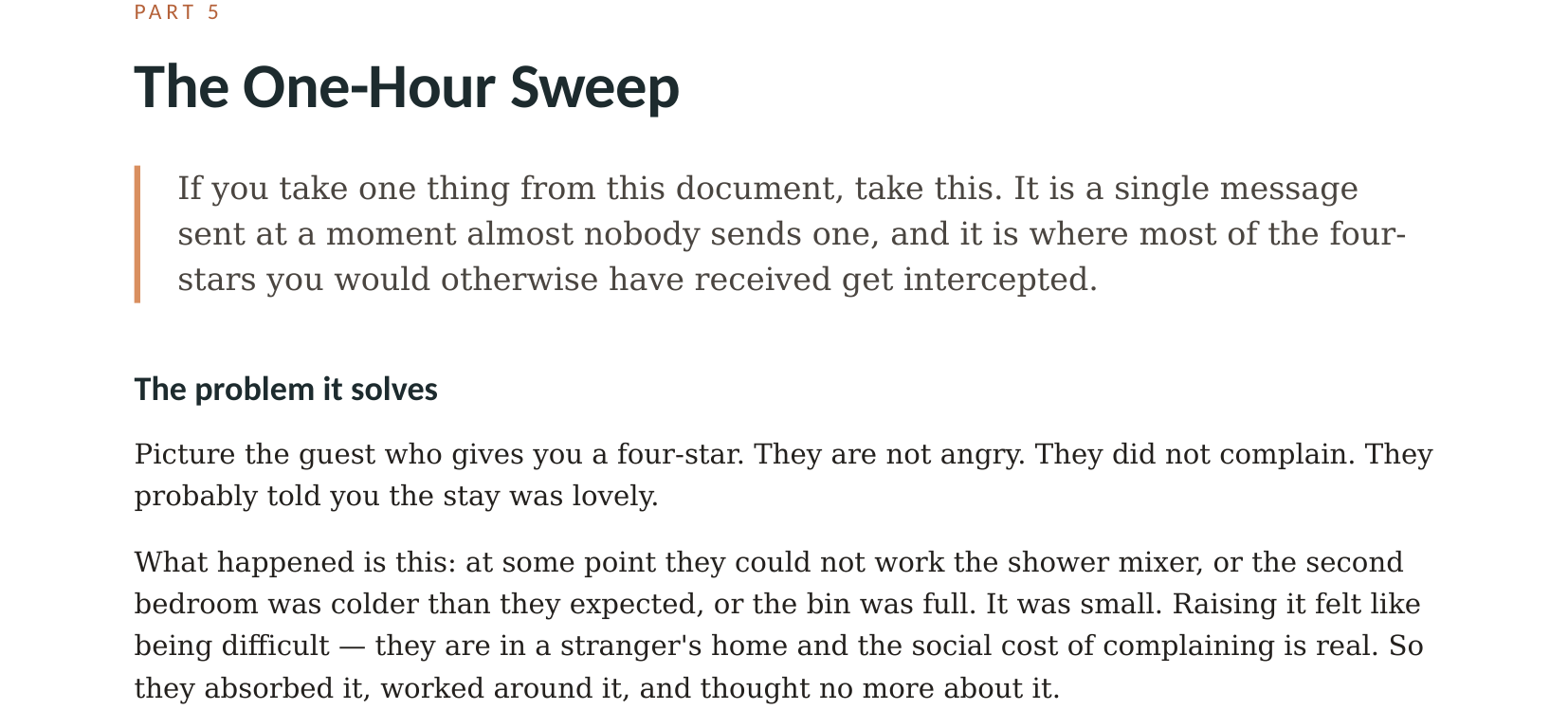
Almost no four-star review is about a bad property. It's about someone who couldn't work the shower, or found the bed harder than expected, or waited forty minutes for a reply. It was small. Raising it felt like being difficult. So they absorbed it — and then it was the only concrete thing they could remember when the rating screen appeared.
You never got the chance to fix something that would have taken ninety seconds.
There are thousands of them. They're Canva templates for wifi passwords and bin days, and the review mechanics are page twelve of twelve. Useful. Not a system.
Genuinely good in fragments, scattered across a hundred threads, contradictory, and almost never sequenced. You'll assemble it eventually — around review nine.
The most commonly suggested shortcut, and a direct policy violation. Reviews must come from real reservations. Hosts get delisted for this. You'd be risking the asset to save three weeks.
About four minutes of work per guest once they're loaded. The order matters more than the wording — each one opens a channel the next uses.
Establishes a human is on the other end, and harvests the one piece of information the arrival gesture runs on.
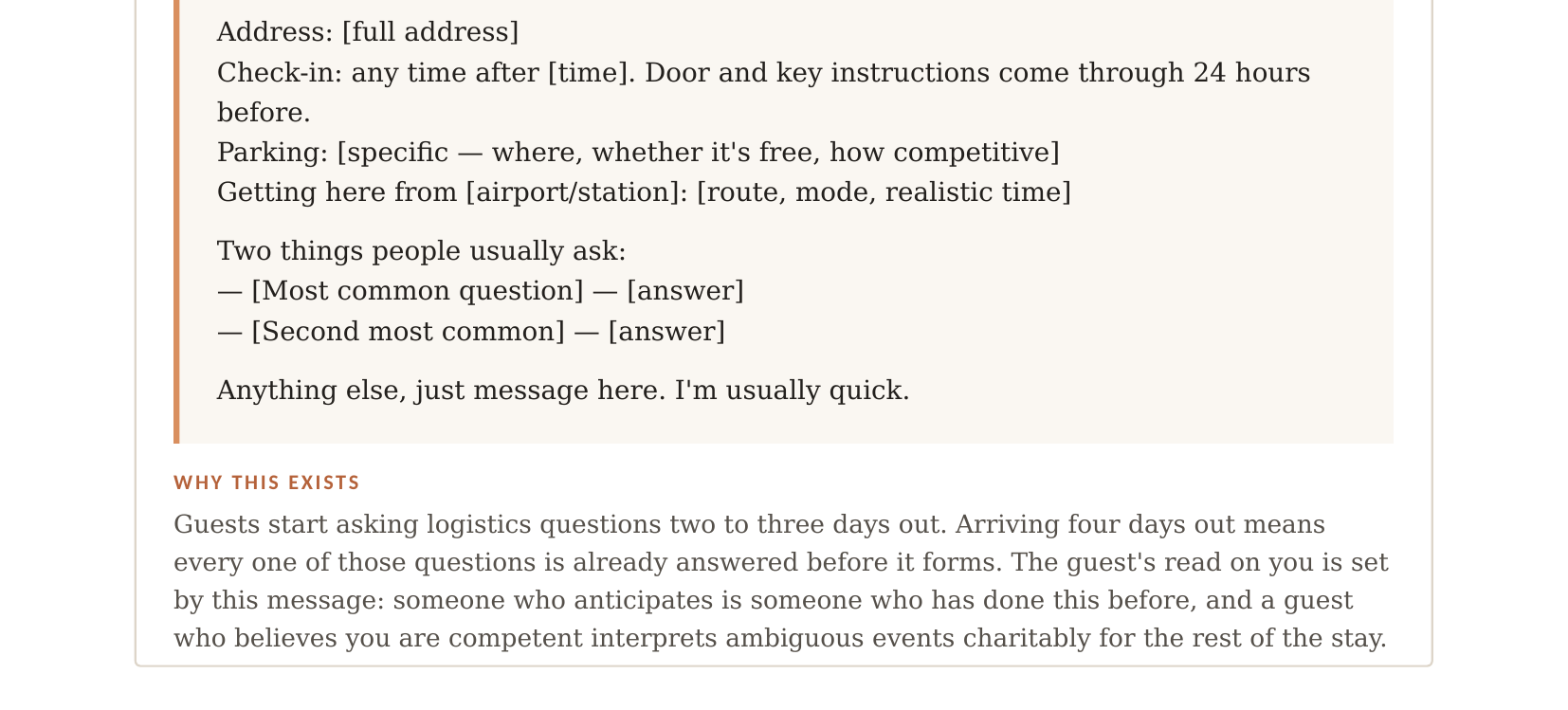
Guests start asking logistics questions three days out. You answer them four days out, before they form.
Sets the standard out loud, and turns complaining from an act of rudeness into an act of cooperation.
The message almost nobody sends, at the only moment it works. This is where the four-stars you'd otherwise have received get intercepted.
Second interception point. Skipped entirely on short stays, where it reads as surveillance.
Last chance to convert a private irritation into a fixed problem rather than a public rating.
One line, sent while they're still travelling — with the platform mechanic that prompts them at the same moment.
This is what you'd be reading on Tuesday.


Why an hour and not on arrival, why one throwaway line is what makes guests answer honestly, and what to do with each thing that comes back.
Under five euros, and it has to break four specific rules to work at all. Expensive gifts produce suspicion, not warmth. Includes the menu for when the guest never answered you.
Broken down clause by clause — how it prices the effort twice in two different units, and the platform mechanic you run immediately before sending it.
The gate and its arithmetic. Sealing the four expectation leaks before booking one. All seven messages with the reasoning behind each. The gesture. The sweep. The ask. The recovery protocol for when a four-star lands anyway. And the compliance line, so you know exactly where it sits.
Every message stripped to copy-paste, with placeholders. Drops straight into Hospitable, Guesty, Hostaway or Airbnb saved replies. Includes the response-handling table, the gesture menu, the public reply formula for a critical review, and the compliance column worth memorising.
I'm Hannah. Most hosting advice comes from hosts — this doesn't, and that's the point.
For the last four years I've run the listings and the online admin for my brother's Airbnb business: four properties, several cities, the actual back office of a real portfolio. I've watched, close up, what moves a rating and what quietly sinks one. The single biggest thing? He's always been openly honest about what's imperfect in each place — the stairs, the noise, the water pressure — and guests love him for it. Disclosed flaws don't cost bookings. They earn trust.
The other half comes from the other side of the door. I've stayed in more than twenty Airbnbs over the years, and the thing I always wished for was simple: a host who actually cared how the stay was going, not just that I checked out on time. That follow-up — the message most hosts never send — is the thing I've built into the middle of this system.
So this is a combination of what genuinely works for a host who's doing it right, and what I, as a guest, wished every host had done. I did the research to back it up, checked every platform claim against Airbnb's own documentation, and put it in the order a brand-new host should actually work through it.
— Hannah, The First Five
One payment. Both files, immediately.
Pieces of it, and the good pieces are genuinely good. What isn't there is the sequence: which message at which hour, why the order holds, and what to do with each thing a guest says back. You'll assemble it eventually. The question is whether you'd rather assemble it before your first five guests or after.
Then that number changes and the mechanics don't. Expectation management, early interception, reciprocity and reviewing your guest first all hold regardless of where the gate sits. The playbook says this explicitly and tells you which page to check, because platforms move thresholds without announcing it.
No, and there's a whole section on why. Nothing here involves fake stays, review swaps, or offering anything in exchange for a review. Airbnb's policy is that reviews must be based on real reservations and can't be incentivised with payment or discounts. This produces the same result legitimately and only slightly slower.
Budget six to eight bookings, not five — a meaningful share of guests don't review whatever you do. The system raises the proportion who do, and more importantly protects the ones you get from landing at four.
Yes. Four of the seven messages can be scheduled in Airbnb's own saved replies. The other three are sent manually, because their timing is the entire point and no scheduler will get it right for you.
No — this is the ideal moment, as long as neither is a four. If one is, read the recovery section first. If both are fives, you have three stays left to run clean.
A download link by email immediately after checkout. It's a digital product — nothing is shipped, and there's no subscription.
Thirty days, no questions asked. EU buyers will be asked at checkout to waive the statutory 14-day withdrawal right in exchange for instant access, which is standard for digital downloads. This refund policy sits on top of that and is more generous than the law requires.